There are many myths circulating around Net Zero. But one of the biggest myths that people think is that getting to Net Zero requires us to be vegan or vegetarian. This puts many off the idea of adapting to a sustainable lifestyle because it is so restrictive.
The path to Net Zero designed by climate change scientists does not involve a world with no one eating meat. We just cannot eat the same amount of meat as we do today. What constrains us is the amount of land we have, the carbon emissions it creates to produce and consume meat and a growing global population.
Being vegan or vegetarian is not necessary
The main problem with billions of people eating a meat rich diet is that it takes up a very large amount of land.
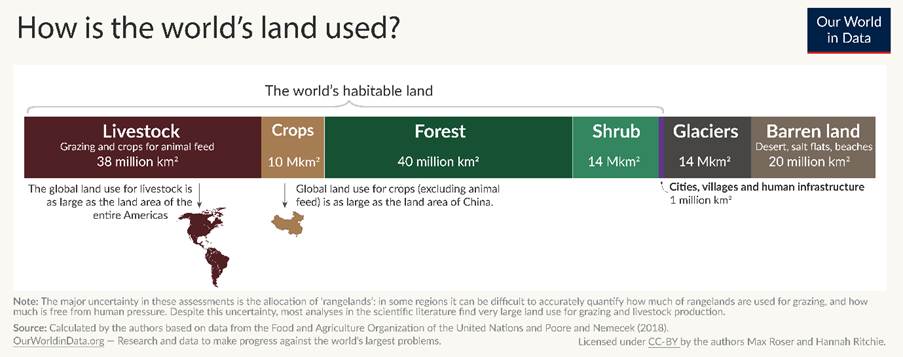
The diagram above show how much of the Earth’s land is used. Humans only occupy 1% of the earth’s surface while raising livestock takes up half of habitable land – the equivalent of the land of North American and South America combined. If the global population continued on its projected growth from 8 billion today to 10 billion by 2050, it would mean a very large amount of deforestation and a further loss of biodiversity.
When trees are cut down, they release carbon dioxide back into the atmosphere. About 5 million of forests are felled each year and currently deforestation contributes between 13-21% to global greenhouse emissions already. This will only get worse if there is greater deforestation and will send global temperatures higher. Deforestation also takes away the ecosystem’s ability to remove carbon dioxide from the atmosphere. This will make it harder to reach Net Zero and live sustainably.
However, we can afford to have some of the current area used for farming to raise livestock, which is why it is not necessary to completely cut out meat.
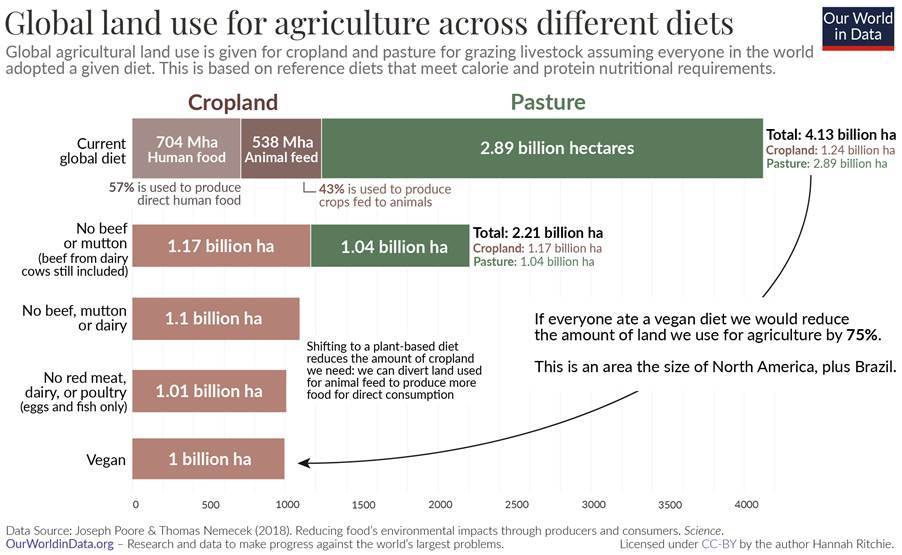
The diagram above shows if everyone was on a vegan diet we could reduce the amount of land used to produce food from 4 billion hectares to 1 billion hectares. But a diet where everyone only cut out beef and lamb would mean we only need 1.17 billion hectares to produce global food supply. Reducing our intake of beef and lamb makes such a difference that even if we just halved the amount of beef we ate, this would free up an area the size of the USA.
Reducing the amount of meat consumed, especially beef and lamb, allows us to reforest areas to absorb carbon dioxide naturally and make it more possible to reach Net Zero and keep down global temperatures.
How much meat and dairy can we eat?
The journey to Net Zero is broken down into two stages. By 2030, we should aim to halve the carbon emissions from the food we eat. What needs to be done will vary by country, but it is recommended that we reduce our meat and dairy intake by 20% by 2030. After 2030, we should aim to reduce our meat intake by another 35% by 2050. By 2050, the maximum amount of meat we can have is 255g a week, 2 eggs a week and 125ml of cow’s milk a day. This does not include meat substitutes such as lab-grown meat or fake meat, so you can eat as many meat alternatives as you like. Moving towards a sustainable diet is a journey rather than a restrictive diet we have to adopt immediately.
What you can do instead
There are two things that will make a big and immediate impact on your diet’s carbon footprint. The first is to cut as much beef as possible out of your diet. Beef is the main cause of deforestation, particularly for the destruction of the Amazon rainforest. The second thing to do is to reduce the amount of food waste you create. There are a number of ways you can tackle food waste. If you are lucky enough to live in an area where the local council collects food waste then you can make use of that. The next option is composting your food. There are lots of different composters from wormeries to hot composters. The final way to reduce your food waste is to freeze what you are not using. You can freeze everything, from bread and vegetables to meat, and it will last after its sell by date. Also be aware how you shop and do not be tempted to over-consume. After you have taken action on these two areas, you can seek ways to reduce meat and dairy in your diet.
Cutting down meat and dairy can be done slowly
Reducing your meat and dairy intake is an important step to cutting your carbon emissions. But there is time to learn and experiment with your diet. There is no need to become vegan or vegetarian at all, let alone immediately. Instead, be open minded to including vegan and vegetarian options in your diet. If you are a regular meat-eater, why not start with experimenting with cooking and see if you can include two meals every week that you like that are meat-free? Diets with a higher number of plants have been proven to be better for our health and our finances, so you are likely to benefit from it in many different ways.
Source:
Our World in Data (2024) ‘Half of the world’s habitable land is used for agriculture’ by Hannah Ritchie and Max Roser
Our World in Data (2021) ‘If the world adopted a plant-based diet, we would reduce global agriculture land use from 4 to 1 billion hectares’ by Hannah Ritchie
Leave a Reply