
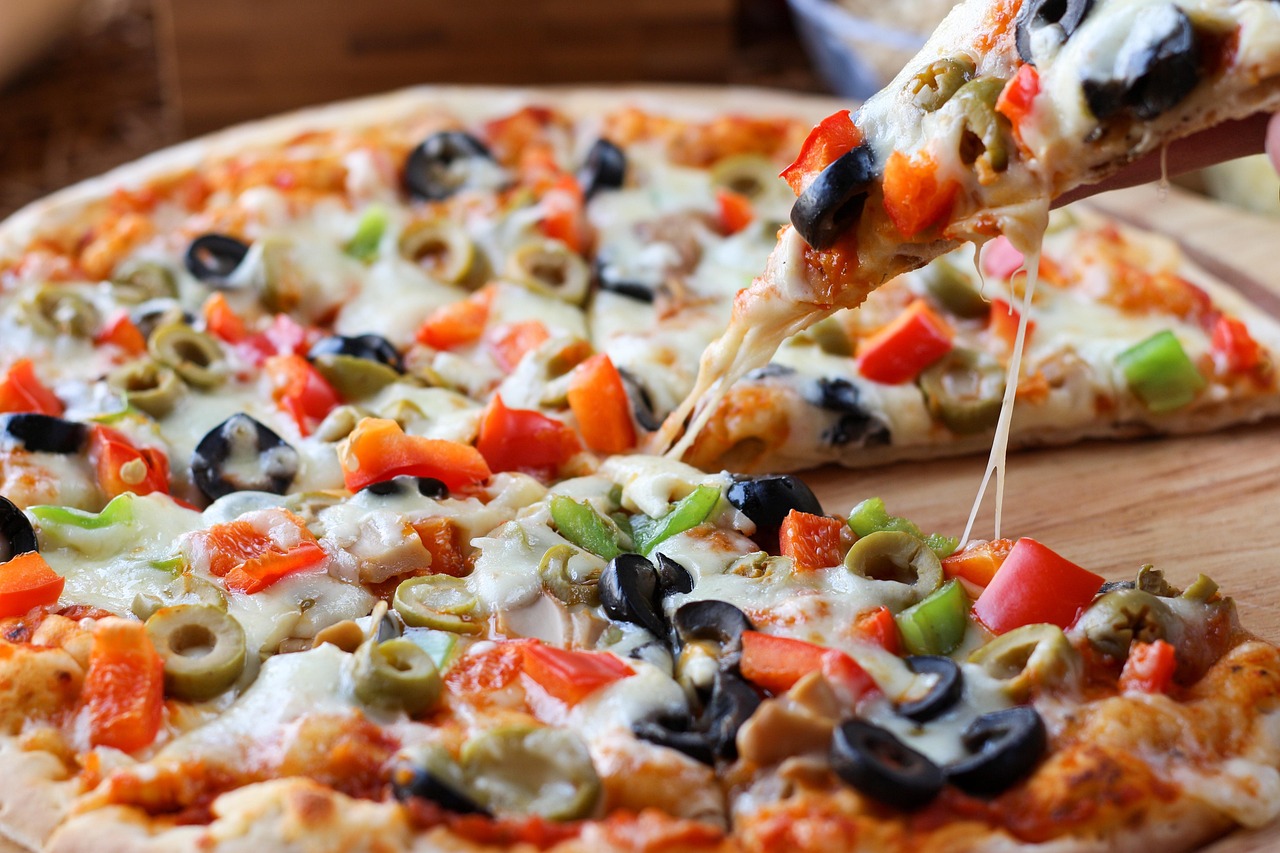
Pizza and burgers are the most popular fast food in the world. Pizza ranks 1st in many countries as the most ordered takeaway and burger chains such as McDonalds dominate the fast-food market. They often feature in our eating habits, so how we can make better choices with pizzas and burgers to lower our carbon footprint?
Pizza
The carbon footprint of a pizza depends on the ingredients, with meat and dairy having a significant impact on the total carbon emissions of a typical pizza.
Pizza and cheese
One thing to think about when choosing a pizza is the amount of cheese that is on a pizza. Professor Bernes-Lee’s book How Bad are Bananas suggests that we should treat cheese as a meat in terms of emissions. Cheese is a dairy product which comes from cows and produces a high amount of carbon emissions. Berners-Lee’s calculations of typical emissions from different types of pizzas show that although a quattro formaggi (four cheeses) pizza is a veggie pizza, a four cheeses pizza has the same amount of emissions as a pepperoni pizza. When you compare a four cheeses pizza to a margherita pizza, which has much less cheese, it has a third less carbon emissions. So, when ordering a pizza try to keep the amount of cheese down or swap for vegan cheese.
For a 10-inch pizza:
Mighty Veg (vegan – no cheese) 1kg CO2e
Margherita pizza 1.4kg CO2e
Four cheeses pizza 2.2kg CO2e
Pepperoni pizza 2.2kg CO2e
Meat feast pizza 2.8kg CO2e
Choosing one cheese over another will not make any difference in reducing emissions. Different types of cheese have similar carbon emissions; whether it is cheddar, mozzarella or parmesan because they all contain cow’s milk. Only choosing a vegan cheese alternative instead will reduce carbon emissions because they avoid meat and dairy. From an environmentally friendly perspective, vegan pizzas are the best ones to choose.
Pizza and meat
Meat always increases the carbon emissions of a meal, particularly beef and lamb. So it is usually better to choose a veggie option over a meat option. If you really want to put meat on your pizza, then chicken, pork or fish are better options than any pizza with beef or lamb. Beef and lamb have a much higher carbon footprint than any other meat because of the way cattle and sheep are raised. This is why there is a big difference in emissions between the pepperoni pizza and a meat feast pizza. Pepperoni pizzas only have pork while meat feast pizzas have beef as well as pork.
Burgers
The carbon footprint of burgers will heavily depend on what type of meat it is made of. Beef has the highest carbon footprint of any meat, so any kind or substitute for beef will make a big difference. Research from Renewable Agriculture and Food Systems Journal (2025) show the typical emissions of the burgers below. If you really like beef burgers, going for a hybrid burger is still a very good alternative.
Beef burger 2.1kg CO2e
Hybrid burger 1.1kg CO2e
Vegetable burger 0.16kg CO2e
McDonalds is the most popular fast-food chain in the world and takes up 40% of the US fast food market. Their burgers have the following carbon footprint:
Double Big Mac 4.46kg CO2e
Quarter pounder 2.99kg CO2e
Bacon double cheese burger 2.87kg CO2e
Big Mac burger 2.35kg CO2e
Chicken burger 0.9kg CO2e
Fillet o’fish burger 0.82kg CO2e
McPlant burger 0.29kg CO2e
The results show adding other meat and dairy products, like bacon and cheese, will increase the carbon footprint of a burger. The Double Big Mac contains the most amount of beef, which is the highest emitting meat. Chicken and fish have a much lower carbon footprint than beef which is why the chicken burgers and fish burgers have less than half the carbon emissions of a beef burger.
The McPlant vegetarian burger has the lowest carbon footprint because plants contain less carbon emissions than meat and only has a third of the carbon emissions of a chicken and fish burger. The vegetables added to burgers such as onions and lettuce make very little difference to the overall carbon footprint of a burger because they are plants. So when it comes to burgers; choosing an alternative to beef makes a really big difference and the most effective choice you can make.
Sources:
How Bad are Bananas? (2020) by Professor Bernes-Lee
Dominguez-Lacueva P., Beriain M.J., and M. Aldaya M. 2025. A comparative analysis of the water and carbon footprints of hybrid, plant-based, and animal-based burgers. Renewable Agriculture and Food Systems, 40, e18, 1–14
The Vegan Society
Leave a Reply